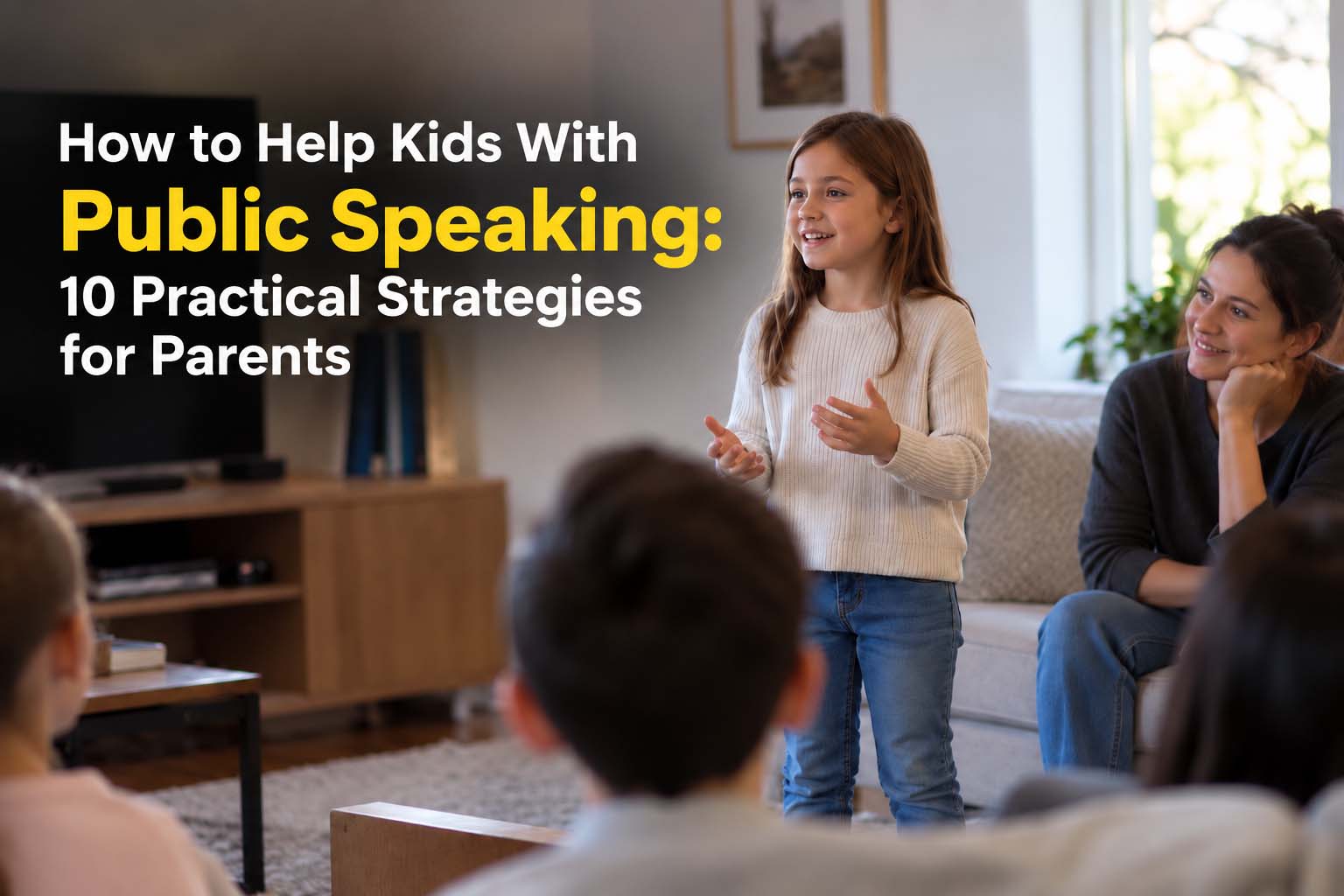
How to Help Kids With Public Speaking: 10 Practical Strategies for Parents
Your kid may keep on talking at home.
They may describe their best game to you, tell you a story they have made up, or argue convincingly about why they deserve ten more minutes of screen time.
Yet ask them to speak in the classroom, introduce themselves to a group, or express an idea out loud, and their confidence seems to vanish.
Does it ring a bell?
For many parents, this raises the important question: how to help children get better at public speaking if they appear confident in some situations but shy in others?
The answer is not to make them more talkative or extroverted.
It is to provide them with chances to communicate, practice, make mistakes, come up with their own ideas, and celebrate small successes.
At Sydney Academy of Public Speaking, we think that public speaking is only the beginning. The aim is not just to turn kids into good speakers. It is to teach kids to become independent communicators able to express ideas, take part in discussions, think creatively, listen to people, and get the chance to engage in leadership activities.
Why Public Speaking Skills Matter for Kids
The skill of public speaking may seem like a very precise talent.
Indeed, children use their communicative abilities every day in different situations.
They ask questions in lessons, introduce themselves to others, express their requests, perform different tasks in a team, present their opinions and resolve conflicts.
In fact, these skills can be utilised later, in real life, during job interviews, presentations, negotiations, etc.
Thus, teaching kids how to master public speaking means preparing them for their future.
That is the idea behind the SAPS method. It teaches public speaking along with other disciplines such as storytelling, personality development, creative thinking, communication skills, body language, debating and group discussions.
The goal?
Not a perfect speaker. A confident communicator.
10 Practical Strategies to Help Kids With Public Speaking
1. Start With Everyday Conversations
You don’t need to say, “From now on, we’ll practise public speaking.”
Instead, begin with a conversation.
Instead of asking:
“How was school?”
You might ask:
“What did you enjoy most about school today?”
Then, you can follow up with:
“What made it so enjoyable?”
Another way is:
“If you had the chance to improve one thing about your school, what would that be?”
These questions prompt children to explain, describe, express their opinions, and support their answers.
This is how public speaking practice starts.
So, if children get comfortable speaking about any subject in everyday conversations, it will also be easier for them to speak in front of a larger audience.
Try it right now:
Give your child one exciting question at dinner and let them talk for one minute nonstop.
No corrections. Just listen.
2. Turn Storytelling Into a Speaking Game
Make Storytelling into a Speaking Game
Children love stories.
They share stories about their day at school, make up characters, create imaginary worlds, and turn simple things into thrilling quests.
Use the opportunity to encourage your child to:
- Make up a story out of three random objects.
- Continue a story you start.
- Retell a movie plot from another character’s point of view.
- Provide an ending to an unfinished story.
- Describe what happened before and after a picture.
The process of storytelling develops a lot more than imagination.
It teaches kids how to arrange their thoughts logically, use emotions, change their pitch, and keep the audience interested.
This is also why storytelling is a core part of the SAPS curriculum.
Remember: a child who learns how to tell a good story is already learning how to connect with an audience.
3. Give Them Time to Find Their Words
Sometimes, kids know exactly what they are going to say but can’t find the words.
A delay doesn’t mean they don’t have the right answer. It just means they are still processing the information.
As parents, it is easy to jump in and finish their sentences for them.
But that is not a good idea.
The pause helps kids learn that they can take their time to think.
Another great activity is “think and say”.
Choose a topic like “If you could invent one thing, what would it be?” and let your child answer the question in 1 minute.
Let the child take 30 seconds to think of the answer first.
There is no right answer to those questions, but the exercise aims to allow kids to think before speaking.
4. Teach Them That Communication Is More Than Words
Let's think about two children stating the same sentence:
"I'm really excited to be here."
However, one of them speaks in a low tone, while the other is firm and has a loud voice.
The words are the same. But the communication is different.
That's why body language and tone are important.
Help your child notice:
- Eye contact
- Posture
- Facial expressions
- Hand gestures
- Voice volume
- Tone
- Pace
- Pauses
Let the child have fun learning.
Have them say the same words showing different emotions like excitement, nervousness, surprise and confidence.
SAPS similarly treats voice, expression and body language as important parts of confident communication.
5. Encourage Speaking Without a Script
Preparation has its advantages.
However, real interactions happen without scripts. A teacher may pose a surprise question, or a companion may disagree with a statement.
One may ask: “Where did you get that idea from?”
Your kid must know how to react in such cases. Thus, impromptu speaking and creative thinking will come in handy.
You should try to give them unexpected themes.
For example:
- “Convince me that weekends should be three days long.”
- “What changes would you make if you were the head of school?”
- “In your opinion, should kids choose their bedtime?”
Give them half a minute to reflect on the topic and allow them to speak.
Do not care about perfect arguments, as you will provide them with something which is more important.
You're developing something more valuable:
the confidence to think, organise and respond.
6. Create Mini Presentation Opportunities at Home
School presentations can be scary because kids don’t get too much practice in low-stress situations.
You can change this at home.
Ask your child to give a two-minute presentation to the family on anything that interests them greatly.
Some examples are:
- Their favorite sport
- A game they play
- A book they like
- A hobby they follow
- An animal they like
- An interesting project they have just worked on at school.
- A place they wish to visit.
Let them choose the topic themselves.
Then give them a simple structure:
- Tell us what it is.
- Tell us why you like it.
Give us three interesting statements about it and end with a sentence that you want us to remember.
7. Let Your Child Have an Opinion
People who are good communicators do not just repeat what is said by others.
They create their own views and take time to talk to your child about his or her thoughts on a particular issue.
Then, ask the following question:
“Why?”
For instance:
“Do you think doing homework is important?”
Follow their answer with another question asking for justification. Another follow-up question might be whether the child can come up with an example.
You might even want to ask if he/she thinks that someone might oppose his/her viewpoint.
This process helps in developing one's critical thinking and persuasive communication skills.
Debate and group discussion can take these skills further by teaching children how to express opinions, listen to opposing ideas and respond respectfully. These are also key elements within the SAPS learning approach.
8. Don't Rush to Fix Every Mistake
This is one of the hardest things for parents to do, but when we see our children struggling to form sentences, we often want to jump in.
- Your child stops.
- They mispronounce a word.
- Their thoughts wander.
- They seem anxious.
It is only natural that we want to step in and correct them.
However, too many corrections can keep a child stuck on the way they talk instead of on what they have to say.
It is best to first let them finish their thoughts.
After that, you may want to choose something they should work on.
For example:
“I really liked what you said. Next time, work on speaking a bit louder.”
That is much more useful than correcting every sentence. Confidence grows when children feel that mistakes are part of learning rather than proof that they aren't good speakers.
9. Celebrate the Brave Moment, Not Just the Perfect Result
Imagine if your child makes a presentation.
- They are anxious.
- They forget one of the sentences.
- They hesitate.
But they persevere and complete their speech.
What should you appreciate?
For doing everything right?
Or just for carrying on despite the anxiety?
The second option is more important.
Try to offer commendation.
“I noticed how you faced your audience while speaking.”
“You kept going even though you forgot that piece.”
“You explained your idea well.”
“You sounded much bolder than last time.”
This helps children understand that confidence is something they can build.
It isn't an on/off switch.
10. Give Them a Safe Place to Practise With Others
Home is an ideal place to start.
However, children also require chances to interact with individuals who are not from their families.
This may involve:
- Communicating with a teacher
- Being involved in a classroom's conversations
- Taking part in team activities
- Joining debates
- Speaking at school
- Participating in storytelling sessions
- Joining structured classes about public speaking for children.
What really matters is the surrounding.
SAPS uses small, supportive classes and practical activities to give children regular opportunities to speak, participate and improve. The focus is on learning through experience rather than simply memorising speeches.
What If My Child Is Shy?
It is a crucial question that parents have concerning public speaking.
Parents should be aware of one point, though:
Being shy does not equal being unable to communicate.
A quiet child can be a successful speaker and yet not be the loudest person in the room. Confidence comes across differently for different children.
- For one child, it may mean raising their hand.
- For another, it may mean going to talk to someone.
- For yet another child, it may mean stating his or her opinion in a group discussion.
The goal is not to change the child but to help them be more confident speaking as themselves.
A child-friendly environment allows children to get used to speaking step by step. SAPS specifically positions its programs as suitable for both naturally outgoing children and those who need encouragement to step outside their comfort zone.
What Parents Should Avoid When Helping Kids With Public Speaking
Knowing what one should avoid is as important as knowing how to carry out any actions.
Never say “Why don't you speak like your friend?”
This can create unhealthy competition among kids.
Do not label them.
For instance, rather than saying “She is shy,” one can state:
“She is learning to be confident.”
The way we communicate can have an impact on children's self-image.
Do not push them to do something.
It is a good idea for a parent to offer activities, but also to make these activities enjoyable and not a burden.
Don't focus only on mistakes.
If every speaking opportunity ends up being full of corrections, kids will try to avoid speaking altogether.
Don't speak for them too quickly.
Make sure children have time to think and answer. Sometimes, children just need some time.
When Should Parents Consider Public Speaking Classes for Kids?
A lot can be done by parents at home.
However, structured courses for public speaking for kids allow them to acquire something that no ordinary family conversations can provide: systematic practice with peers, diverse audiences, organised activities and feedback.
While looking for a suitable public speaking course for children, it is important to look for much more than just memorising speeches.
Ask whether the program includes:
- Public Speaking
- Voice Modulation
- Tone and Body Language
- Team Work
- Speech Writing
- Persuasive Writing
- Creative Thinking
- Impromptu Speaking
- Soft Skills
- Personality Development
Such an all-round approach lies at the root of SAPS.
SAPS is a program that combines all these aspects, since successful communication skills cannot be developed through one skill alone.
And importantly, children don't need to arrive at their first class already confident.
That's what they're there to build.
A 5-Minute Public Speaking Challenge for Parents
Want to start today? Try this simple weekly challenge.
Monday: Tell
Ask your child to tell you about one interesting thing that happened that day.
Tuesday: Explain
Ask them to explain how to do something they know well.
Wednesday: Imagine
Give them a “What if?” question and let them create an answer.
Thursday: Persuade
Ask them to convince you of an opinion.
Friday: Present
Give them two minutes to talk about something they love.
- Keep it light.
- Keep it positive.
And most importantly, listen.
Sometimes the most powerful public speaking practice is simply giving a child the feeling that someone genuinely wants to hear what they have to say.
The Goal Isn't to Raise a Child Who Loves the Stage
Here's the bigger picture. Your child may never want to become a professional speaker.
They may never stand in front of hundreds of people, and that's perfectly fine.
The value of public speaking is what happens before and after the stage.
- It's the confidence to ask a question.
- The ability to explain an idea.
- The courage to introduce yourself.
- The skill to disagree respectfully.
- The creativity to think of an answer.
- The confidence to participate in a group.
- The ability to speak up when something matters.
That is why, at SAPS, public speaking is just the beginning.
The wider goal is to help children find their voice, communicate with confidence and develop the life skills that can help them become capable young leaders. SAPS describes this as going “more than public speaking,” with practical, activity-based learning combining communication with leadership, creativity and emotional intelligence.
Because the most important question isn't:
“Can my child give a good speech?”
It's:
“Does my child feel confident enough to speak when they have something worth saying?”
And every time you give them the opportunity to speak, listen, think and try again, you're helping build that confidence.
Frequently Asked Questions
How can I help my child improve their public speaking skills?
Starting with everyday conversation, storytelling, small presentations, opinion-related questions and various fun spontaneous speaking practices are proven to help. Allow your child to think, avoid correcting unnecessarily and focus on progress.
What are the best activities for public speaking for kids?
Storytelling, role-playing, giving presentations, debating, group discussion, creative thinking games and spontaneous speaking are some of the best examples. The most successful activities, however, give children various chances to speak, listen, think and reply.
How do I help a shy child with public speaking?
Do not make your child perform or compare them to more open people. Start with speaking tasks which are simple and make them more challenging as soon as your child gets used to performing.
Should my child join public speaking classes?
Public speaking lessons for children can be beneficial if your child wants to practice speaking often and get feedback on their performance. It is important that you choose a program that helps children to communicate effectively with others and become more confident speaking in public.
At what age can children start learning public speaking?
Children can acquire communication skills by talking, playing and telling stories from an early age. Subsequently, they can enrol in a more structured program focusing on public speaking itself and featuring age-appropriate tips.
Give Your Child the Confidence to Find Their Voice
Each kid has opinions that deserve to be told.
At times, those kids require an opportunity to learn how to express them boldly.
At Sydney Academy Public Speaking, kids learn by doing – speaking, telling stories, debating, being innovative, collaborating, and risking. With Term 4 enrolments now open, children across Sydney can join SAPS's age-based programs at five locations across five Sydney locations, such as Melonba, Quakers Hill, Ponds, Westmead and Marsden Park. So whether your child is naturally confident, still finding their voice, or somewhere in between, Term 4 is another opportunity to help them practise, participate and grow.
Because public speaking isn't the finish line. It's where confidence begins.