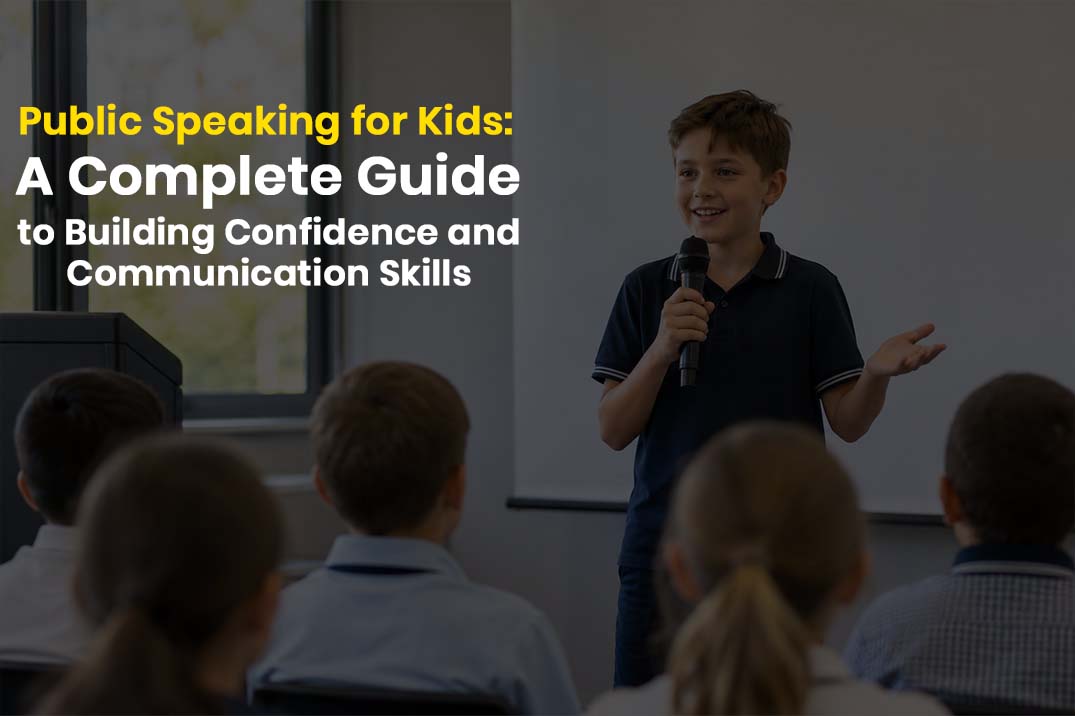
Public Speaking for Kids: A Complete Guide to Building Confidence and Communication Skills
All kids have something to say.
Whether it's a silly anecdote they want to tell, a thought they can't wait to share, a conviction they have, or a query they're itching to raise.
But being aware of what to say differs from having the guts to say it. In these instances, the work that we do with kids on public speaking becomes a game changer.
Public speaking for kids entails more than taking a podium or holding a microphone and speaking. For children, being able to speak is about expressing themselves logically, listening carefully, thinking quickly, and communicating easily.
At Sydney Academy of Public Speaking (SAPS), we see public speaking as a broader concept. Our method is based on combining speaking skills with storytelling, creative thinking, debating, discussing, body language, and personality development so that kids grow into great communicators both at school and outside the classroom.
So, what does that really look like for a child?
What Is Public Speaking for Kids?
Public speaking for kids means empowering children with the right tools to express themselves confidently in front of an audience.
This can be as simple as:
- Introducing oneself to a new group
- Presenting a school project
- Telling a story to an audience
- Sharing an opinion in a group discussion
- Participating in a debate
- Answering a spontaneous question
- Speaking up on something that disturbs them
- Applying for a leadership role within a group.
The aim here is not to make performers out of kids. The aim is to enable every child to find his or her own voice.
An effective public speaking course gives children many chances to speak and learn the necessary skills, as well as attain confidence and structure that will help them to express their thoughts naturally.
Why Do Communication Skills Matter So Much for Children?
Consider how often children communicate with others.
They talk to teachers, friends, brothers and sisters, coaches and relatives. Children ask questions in class and work with classmates in their group work, express their thoughts, share things with others and finally present themselves during job interviews.
Communication is a crucial part of the majority of activities children have.
Once children learn the ways to communicate clearly, they will become more confident because they will be able to participate in public activities and be more active in their communication.
That’s why public speaking is a skill not only for school presentation purposes.
It is a life skill.
Public Speaking Isn't Just About Speaking
One of the common misconceptions regarding public speaking courses is that kids learn only how to write speeches as well as deliver them.
However, being able to speak in a confident manner is much more complicated than that.
1. Confidence
A child knows what message they want to convey but does not say what they planned to say.
Children become comfortable speaking through practice because, with enough motivation, they understand that mistakes are simply part of the road to improvement.
2. Communication
Confidently speaking also means speaking loudly.
As children learn to structure their thoughts, to compose sentences, and even use their intonation properly so that the message is understood.
3. Body Language
Even when we communicate, words hold only a small share of the message we convey.
It has been proven that a person’s body movements, expressions, posture, and tone of voice also play an important part when communicating ideas. Thus, the more a child learns about how to speak confidently, the more they become aware of the way of presenting themselves.
4. Creative Thinking
Have you ever thought of the situation when a teacher suddenly asks, “If you were a director for a day, what would you do?” It is evident that for effective communication, one should not only learn how to talk but also think.
The activities for developing creativity will help a child get new ideas and analyse various situations from different points of view without using any scripts.
5. Listening and Group Discussion
Being able to exchange information constitutes two-sided communication.
Kids also have to acquire the ability to listen, react properly, follow the cues given by others and paraphrase respectfully.
It is possible to practice these skills through group discussions, which provide opportunities for developing teamwork spirit and social confidence.
6. Personality Development
Confidence should not be confined only to public speaking.
It can affect how well children are able to present themselves and communicate with the environment around them since it will be used when facing new situations, difficulties, and opportunities.
That is why adopting a wider approach in respect of 360* personality development can increase the effects of public speaking learning.
What Happens in Public Speaking Classes for Kids?
The greatest learning experiences avoid making students feel like they are listening to lectures. Instead, learning becomes engaging.
At SAPS, students acquire the skill of communicating through hands-on experience with activities like storytelling, presentations, debates, group discussions, and creative tasks.
One example of a learning journey involves:
- Storytelling:
Students learn to think of ideas, express them, and make their stories interesting.
- Presentations:
They learn to gather information and share it effectively with audiences.
- Debates:
They learn to form an opinion and provide arguments.
- Group Discussion:
They learn to listen and communicate with each other by respecting different points of view.
- Body language and tone:
They find out how body positioning, looking into people's eyes, voice, and expressions help in communicating with others.
- Creative thinking:
They learn to come up with ideas and respond creatively.
The important part is progression.
A child who is initially reluctant to speak may begin with a simple activity, then gradually move towards speaking in a small group, presenting an idea and eventually addressing a larger audience.
Can Public Speaking Help a Shy Child?
Confidence should not be imposed.
A timid child does not need to become the most talkative person in the room. They must be assured enough to start taking part.
For some kids, the first step can be just answering a question in front of a few people. For another one, making eye contact while speaking can be the first step. And for some people, it can be volunteering to share an idea.
Confidence comes differently to every child.
Сhildren should feel supported, have practice and get positive feedback in order to achieve these little steps without worrying about being judged. SAPS emphasises small and gradual speaking experience as opposed to making every class feel like a formal speech.
And sometimes the biggest change does not occur when the kid becomes brave.
It occurs when they accept the fact:
“I can be nervous and still speak”
This is the real confidence.
How Can Parents Encourage Public Speaking at Home?
There is no need for a stage in your household to help your kid become a great communicator. You must look for ways to turn ordinary moments into brief speaking opportunities.
Ask open-ended questions:
For example, ask "Did you have fun at school?" instead of "What was the best thing you learned today?"
Let them explain things:
Teach your kid how to teach you to play a game, an interesting hobby or anything they do.
Encourage storytelling:
Have your kid create a story using three random objects lying around the house.
Practise impromptu speaking:
Give your kid a simple topic, then give him or her 30 seconds to think before speaking for 30 seconds.
Don't interrupt too quickly:
Give your kid time to finish their thoughts, even if it takes longer than you'd expect.
Celebrate progress, not perfection:
Ask what went well instead of focusing all the attention on mistakes.
Most importantly, let your child know that their ideas are worth hearing.
What Should Parents Look for in Public Speaking Courses for Kids?
Not all public speaking programs are suitable for all children.
When selecting public speaking programs for children, it is important to keep more than just the “better speaker” promise in mind.
Consider:
- Is the program designed for the right age group?
- Can children practice their public speaking skills in a meaningful way?
- Is the focus on children speaking rather than memorising speeches?
- Does the curriculum teach valuable subjects such as communication, confidence, and social skills?
- Will children learn how to tell stories, hold debates and converse in groups?
- Will children receive feedback on their performance?
- Is the atmosphere supportive of timider children?
- Will children be able to use their skills outside of the classroom?
At SAPS, we believe that public speaking is only a part of the whole training. Our program incorporates leadership, creativity, storytelling, group activities, and personality development into the whole approach.
Public Speaking for Kids: A Skill That Grows With Them
In the present day, children who learn to talk with confidence can carry that confidence into tomorrow.
This can mean:
- Raising their hand in the classroom.
- Defending a friend.
- Meeting a new person.
- Presenting a project at school.
- Taking part in a debate.
- Becoming a group leader.
- Or just having the ability to express themselves freely.
That is why public speaking for kids is more than just giving speeches.
It is ultimately about giving kids the confidence to get involved, the skills to communicate, the creativity to think outside the box, and the guts to convey their ideas.
At SAPS, we believe that every child has something to say that should be heard.
Because public speaking is just the beginning.
Frequently Asked Questions
At what age should children start public speaking?
Kids can learn public speaking quite early by doing things like storytelling, taking part in role-plays, performing in show-and-tell and talking to groups. After that, more formal education can take over.
Is public speaking suitable for shy children?
Definitely! Public speaking is especially effective for shy kids provided they are put in a conducive environment. It is critical not to push the child into becoming extroverted but rather to instil confidence in them so that they feel at ease communicating.
What do kids learn in public speaking classes?
Public speaking allows kids to work on their confidence when speaking, communicating well, telling stories, giving presentations, using body language and thinking creatively.
How can I improve my child's public speaking skills at home?
Give kids many chances to talk through their thoughts, share stories, answer exploratory questions and discuss things that interest them. Be supportive and look at their improvements instead of trying to achieve the best results.
Where can I find public speaking classes for kids in Sydney?
Parents interested in their kids taking part in courses on public speaking in Sydney may find relevant educational options that are practical and help to build kids' confidence and communication skills. Currently, SAPS holds age-based programs throughout various sites: Melonba, Marsden Park, The Ponds, Quakers Hill and Westmead.
Ready to Help Your Child Find Their Voice?
Confidence begins when someone takes the first opportunity to speak.
Sydney Academy of Public Speaking teaches children to express themselves confidently, clearly and creatively through engaging and practical activities that help them evolve both on and off the stage.
Allow your child to have the chance to speak, participate, learn and lead. The confidence they gain today will last for a lifetime.
Book a Free Trial Class with SAPS and let your child discover their voice.