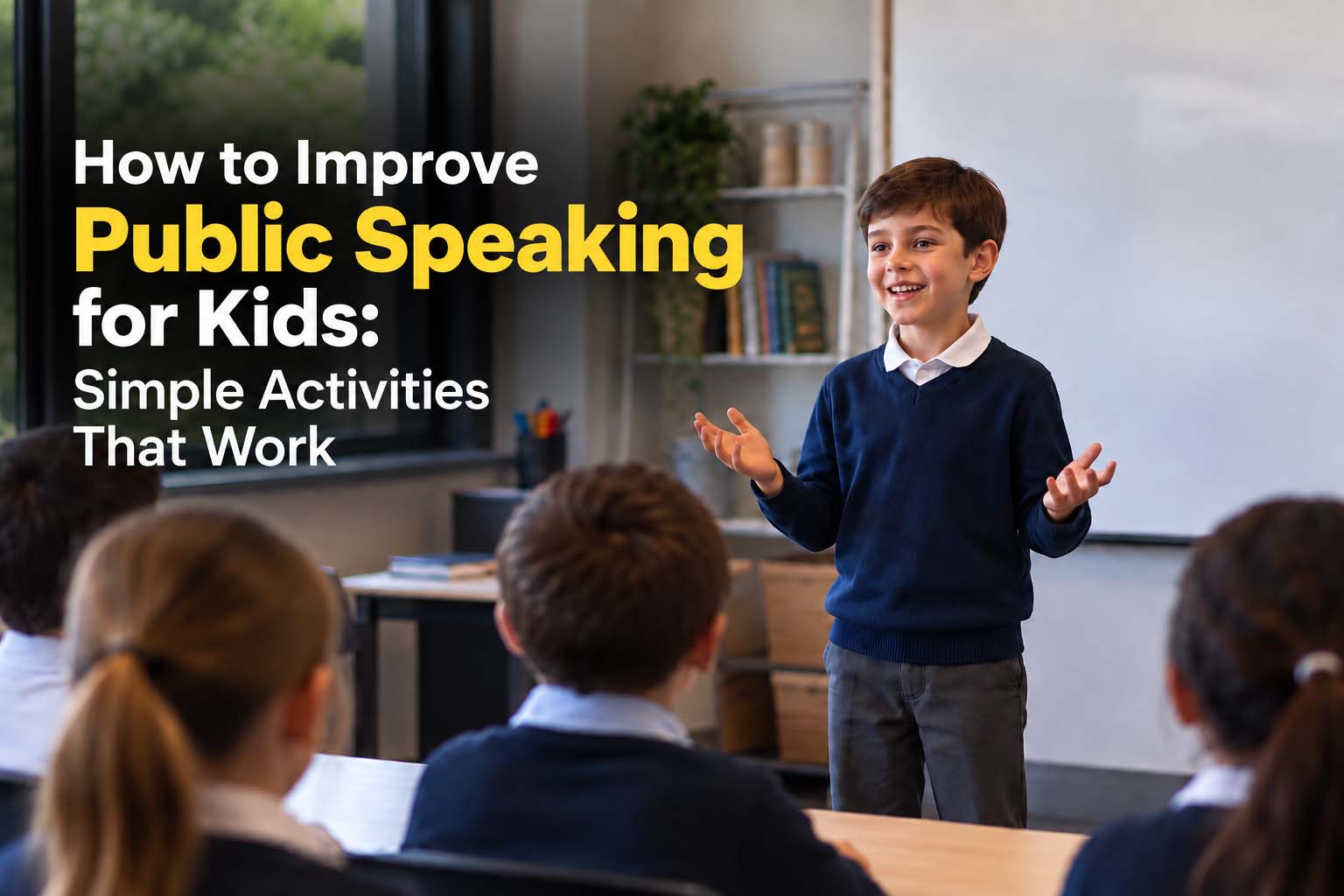
How to Improve Public Speaking for Kids: Simple Activities That Work
Your child can talk nonstop about their favourite game for 20 minutes.
Your child can recount everything that happened at school, including all the incidents that made them laugh. They may even be able to explain why their favourite superhero is the greatest.
However, if you place them in front of an audience and ask them to speak, they will seize up.
So, how do you improve public speaking for kids?
The answer isn't simply telling them to "speak louder" or suggesting "to be confident."
Confidence is gained through experience. The more they have chances to express their opinion, tell stories, be spontaneous, listen to their peers, practice speaking, etc., the better speakers they will be.
At the Sydney Academy of Public Speaking, we understand that. Public speaking is just the beginning. By providing fun and hands-on activities for kids, we help them develop strong communication skills, confidence, creativity, storytelling skills, debate skills, group discussion skills, body language, and leadership skills.
And there’s good news for parents?
You don’t need to have a stage and a microphone to begin with.
Some of the best public speaking exercises for kids can happen at home, in the car, around the dinner table or during everyday conversations.
Why Do Kids Need to Practise Public Speaking?
There is more to public speaking than just speech preparation.
Children are used to communicating all the time. They answer questions throughout a lesson, introduce themselves to other kids, explain their thoughts to classmates, engage in group activities and provide their opinions all the time.
With communication skills and confidence developed, children will be eager to participate, ask questions and get involved with new opportunities.
That’s why SAPS goes further than public speaking. SAPS programs aim to teach children how to communicate naturally and with confidence in different situations, because just delivering the speech is not enough.
The goal isn't:
“Can my child give a perfect speech?”
It's:
“Can my child confidently express what they think, feel and believe?”
That's a much bigger skill.
5 Simple Activities to Improve Public Speaking for Kids
The best activities don't feel like homework. They feel like games.
Here are five simple ways parents can help children practise public speaking while keeping it enjoyable.
1. The One-Minute Story
Ask your kid:
“Can you tell me what the most exciting part of your day was today?”
There’s only one condition: they have sixty seconds.
Give them a few seconds to prepare before they start talking.
- Don’t interfere.
- Don’t correct every detail.
Just listen.
Once your child feels at ease, you can make it even more interesting:
“Now tell the same story as a teacher.”
Or:
“What do you think would have happened if you’d made a different decision?”
This simple activity helps develop children’s narrative skills, sequencing, and the ability to get engaged in communication.
Storytelling is an integral part of the SAPS curriculum since it teaches children to express their thoughts and be able to interpret them rather than just repeating the information.
Make it more interactive:
You can also ask your child:
“What part of your story do you find the most interesting?”
You're now encouraging them to think about their audience as well as their message.
2. The Mystery Object Challenge
Choose a random item lying around the house, maybe a spoon, toy, book, shoe or bottle.
Give it to the kids and say:
“You have 30 seconds to think of three interesting features of this object.”
Want to make it more challenging?
Ask the children to make a claim that the object is the best invention in the world.
This may sound foolish, but it works! Kids have to think quickly, structure their thoughts and communicate without having time to prepare.
The activity introduces kids to impromptu speaking as a skill that helps them to think clearly rather than memorise hundreds of phrases.
3. The Family Debate
Select a subject that interests your child.
For example, ask:
- “Should kids have homework over the weekend?"
- “Do you think sleep time should be later on Fridays?"
- “Should schools have longer lunch breaks?”
Give your child one of the two opinions to consider.
Later, have them state:
- Their opinion
- Two arguments
- One example.
Next, switch sides and ask your child to argue the opposite view.
This exercise teaches an important skill:
Good communication isn't just about speaking. It's also about understanding another point of view.
Debate and discussions form part of SAPS's general curriculum, as they teach children different opinions, good listening skills and respectful communication with others.
4. Teach Me Something
Kids have a passion for sharing their expertise. So encourage them to share during the next few minutes.
Get your child to explain something they are skilled at.
Here are some examples:
- How to play their favourite video game
- How to draw an object
- How a favourite sport works
- How to make something
- How to use an app
- How to take care of a pet
You give them three minutes.
They must explain whatever they are going to say in such a way that you would be able to carry it out.
This exercise gives children a chance to practice logical thinking while making adjustments in the way they express their ideas.
And there is one more advantage:
They will be talking about something they already know well.
5. The “What Would You Do?” Game
Public speaking is not just about pre-planned responses. There are times when a child needs to think on their feet and answer right away.
That is where this activity comes in.
Questions you can ask include:
- “What would you do if you came across a stray puppy?”
- “What would you change in your school if you were the principal for a day?”
- “What would you do if one of your friends does not get picked up for a game?”
- “What would happen if all the screens were turned off for a week?”
You are not looking for the “right” answer.
Simply ask: “Why?”
Then: “How did you come up with that?”
Finally: “Is there another way of looking at it?”
You are helping your child to develop skills for creative thinking, critical reasoning, and spontaneous communication that will help them in life.
What If My Child Is Shy?
A common myth about public speaking is that confident speakers are naturally outgoing people and have to be that way.
Not at all.
A reserved child can learn to communicate effectively. The aim isn’t to change their personality, but to help them feel confident in expressing it.
For one child, success might mean answering a question in front of three people.
For another, it could mean making eye contact.
For another, it could mean taking the initiative to present their thoughts.
This explains why gradual and effective practice is so important for such matters.
SAPS’ programs in public speaking cater to children who differ in confidence levels, including children who don’t want to speak. The program has a practical focus; children are offered small, supportive groups to help them practice rather than being expected to come confidently to class.
There’s no need for them to be ready; that’s what they are here for!
Public Speaking Practice Should Go Beyond the Stage
If your child becomes better at giving a speech, that's great.
But imagine they also become more comfortable:
- Introducing themselves to someone new
- Asking a teacher a question
- Sharing an idea in class
- Participating in group work
- Explaining how they feel
- Respectfully disagreeing
- Taking the lead in an activity
- Thinking of an answer when they aren't prepared
That's where public speaking becomes a genuine life skill.
The current SAPS approach reflects this broader purpose. Its mission is to build confident young leaders, using public speaking alongside leadership, creativity, emotional intelligence and real-world speaking experiences.
Because the real transformation isn't necessarily hearing your child deliver a perfect speech.
It might be hearing them say:
“I have an idea.”
And then watching them confidently share it.
When Should Kids Join Public Speaking Classes?
Family activities are great for getting started. However, structured public speaking classes for kids can deliver one thing that is hard to create at home: regular possibilities of speaking to peers and audiences, coached activities, and feedback.
When selecting a program, you should not choose those that focus only on rehearsing speeches.
Look for a program that includes:
- Public Speaking
- Voice Modulation
- Tone and Body Language
- Team Work
- Speech Writing
- Persuasive Writing
- Creative Thinking
- Impromptu Speaking
- Soft Skills
- Personality Development
This broader approach helps children develop the ability to think, communicate and participate, rather than simply remember a speech.
SAPS's current program is built around this practical philosophy, with children learning through presentations, storytelling, impromptu speaking, group discussions and interactive classroom activities.
A Simple 7-Day Public Speaking Challenge
Want to start helping your child this week?
Try this:
Day 1 - Tell:
Tell a one-minute story about something that happened today.
Day 2 - Explain:
Teach them how to do something you know well.
Day 3 - Imagine:
Answer a “What if?” question.
Day 4 - Persuade:
Convince them of an opinion.
Day 5 - Create:
Make up a story from a random picture.
Day 6 - Debate:
Argue both sides of a fun topic.
Day 7 - Present:
Give a two-minute presentation about something they love.
That's just 5–10 minutes a day.
No marks. No pressure. No need to get everything right.
Just seven more opportunities to speak.
Frequently Asked Questions
How can I improve my child's public speaking skills at home?
Start with short, enjoyable activities such as storytelling, family presentations, opinion-based questions, debates and impromptu speaking games. Give your child time to think, avoid correcting every mistake and celebrate progress.
What are the best public speaking activities for kids?
Storytelling, picture-based stories, mini presentations, role play, debates, “What would you do?” scenarios, and teaching activities are excellent ways to develop speaking, creative thinking and communication skills.
How can I make public speaking fun for my child?
Keep activities short and interactive. Let your child choose topics they enjoy, turn speaking into games and use silly or imaginative scenarios. The less it feels like an assessment, the more naturally many children participate.
Can public speaking help shy children?
Yes. Public speaking can help shy children become more comfortable expressing themselves when the learning environment is supportive and gradual. The goal isn't to make them more outgoing; it is to help them communicate confidently in their own way.
What skills do children develop through public speaking?
Children can develop confidence, communication, storytelling, presentation, listening, creative thinking, debate, body language, teamwork and leadership skills. These abilities can support children both inside and outside the classroom.
Are public speaking classes useful if my child is already confident?
Absolutely. Public speaking classes aren't only for nervous children. Confident children can strengthen their communication, presentation, creative thinking, debate and leadership skills while learning how to communicate effectively with different audiences.
Help Your Child Find Their Voice
Each child has something to tell.
From time to time, they just need more chances to figure out how to do it.
Whether this starts with a one-minute story at the dinner table, a fun family argument or a two-minute talk about one’s favourite hobby, each speaking situation can be a tiny step to greater confidence.
To make it possible, Sydney Academy of Public Speaking aims to provide kids with practical knowledge by encouraging them to speak, tell stories, think creatively and work in pairs. With Term 4 enrolments now open, children across Sydney can join SAPS's age-based programs at five locations across five Sydney locations, such as Melonba, Quakers Hill, Ponds, Westmead and Marsden Park. So whether your child is naturally confident, still finding their voice or somewhere in between, Term 4 is another opportunity to help them practise, participate and grow.
Because public speaking is just the beginning.
The real goal is a child who believes their voice is worth hearing.