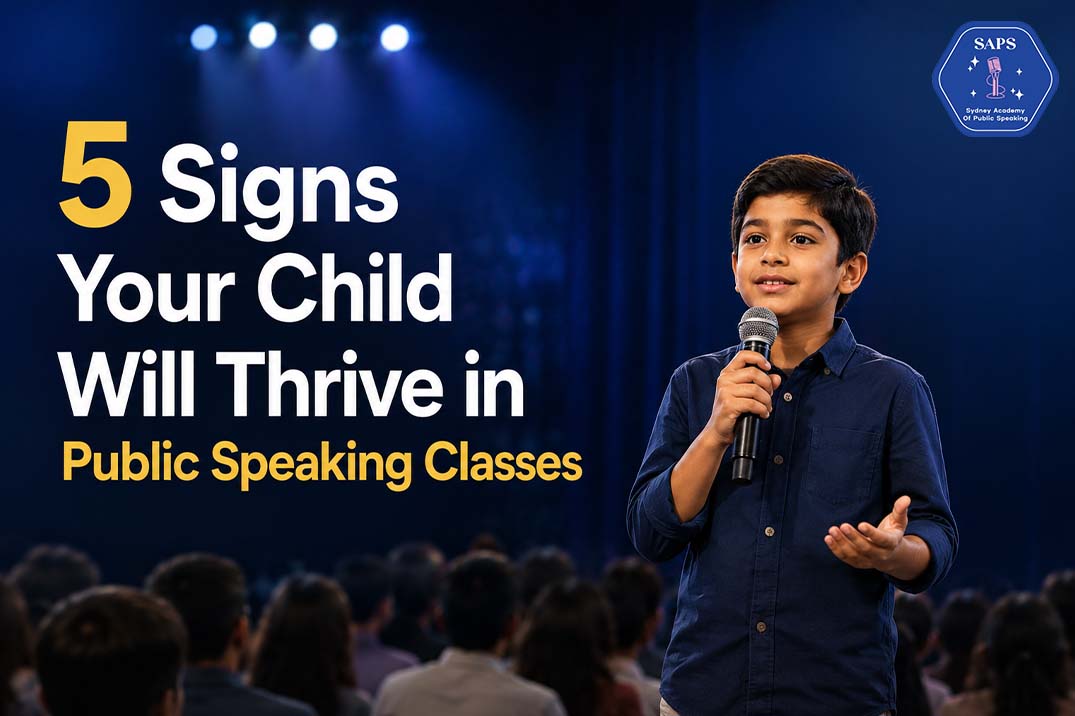
5 Signs Your Child Will Thrive in Public Speaking Classes
Does your child love telling stories, asking questions, sharing ideas or taking the lead during play? These everyday behaviours could be signs that they are ready to develop their communication skills through public speaking classes.
Public speaking is an important skill to build from a young age. It enhances their confidence in expressing themselves, communicating with others, participating in classroom activities and performing in front of an audience.
One of the common myths is that public speaking classes are only useful for naturally outgoing people. In reality, public speaking classes can be useful for people of all personalities. For instance, an outgoing child may enjoy learning more about public speaking, while a child who is less outgoing can learn to build the confidence needed to speak in public.
If you are interested in public speaking classes for kids in Sydney, here are five signs that indicate that your child can benefit from a friendly public speaking class.
1. Your Child Loves Telling Stories
Is your child always excited to share their daily school activities, come up with interesting fictional stories, or create heroic figures during games?
The ability to tell stories comes in very handy in public speaking.
Storytelling helps children organise their ideas, deliver a message in an organised form, and use expression and tone effectively. Through storytelling, children learn that communication is not just about what you say but also about presentation.
Storytelling activities in public speaking help children:
- Structure their ideas in a comprehensive way
- Work on their tone of voice
- Speak in a clear and confident manner
- Keep listeners’ attention
- Apply creativity in their speeches
- Convey emotions through voice and gestures
The best part is that children can develop these skills while doing something they already enjoy.
A child who loves telling stories at home may discover that their natural creativity can become a valuable communication strength.
2. Your Child Is Curious and Loves Asking Questions
"Why?" "How?" "What if?"
If your kid is always questioning various things, he might already be developing one of the vital characteristics of efficient communication - curiosity.
Curious children also usually enjoy learning about diverse topics and ideas and how things work, which can provide benefits when they start refining their speaking and conversation skills.
Public speaking doesn't mean only addressing the audience. Confident speakers also have to think about what they want to say or share any knowledge and how their audience might react to this.
Through suitable activities for their age, children can learn how to turn their curiosity into meaningful communication, and they can possibly be invited to present a topic or explain an idea. Moreover, this also promotes the development of creativity and critical thinking, boosting children's confidence.
If your child is curious by nature, attending public speaking classes will provide him with an opportunity to thrive in an inspiring environment where all his questions and ideas can be used in the process of learning.
3. Your Child Enjoys Sharing Their Ideas
Some children always have an opinion to share.
These children can explain with enthusiasm about their favourite book, come up with ways of solving issues, or simply suggest the next step in the family affairs. For some parents, it might be quite entertaining, yet the ability to form an opinion is a crucial skill.
Public speaking may help children turn those everyday thoughts into organised communication.
They can learn how to:
- Organise their thoughts
- Explain an opinion clearly
- Give reasons to support an idea
- Listen to different perspectives
- Respond respectfully
- Communicate with confidence
Not only do children use these skills when speaking in public, but also during conversations in class, presentations in school, working in groups, communicating socially, and in other situations.
If children like to express their opinions, a structured program can help provide them with the necessary knowledge and skills to be able to do it.
4. Your Child Is Willing to Try Something New
Your kid doesn't need to be totally fearless in order to excel at public speaking.
In fact, a kid that feels slightly anxious yet is willing to give it a try might just be the kid with the right mindset to begin building his or her confidence.
Public speaking is a learned skill. Children may initially dislike talking in front of people, presenting an idea, speaking in front of a group, or stepping in front of an audience. Fortunately, if they are given enough chances to try these things out, they might eventually get used to public speaking.
This is the reason why it is important to create a positive learning environment.
At Sydney Academy of Public Speaking (SAPS), children are welcome to take their time. In the process of doing such fun things as telling stories, playing games, participating in discussions and acting, children learn how to speak in public and gain confidence.
Little achievements matter. When a kid feels comfortable enough to answer a question, he or she may be able to speak in front of a class. The aim is not to make children the loudest people but to make them feel comfortable speaking.
5. Your Child Wants to Connect With Others
The act of delivering words in front of a group of people can be seen as public speaking, but communication is about establishing a connection with others.
Any child who likes to play and compete with peers, take part in community service, talk to others or spend time doing things together may enjoy the collaborative aspect of public speaking.
Children can get involved not only in presenting but also in group discussions or teamwork tasks. They can make stories, role-play, or work on solving non-standard tasks together.
In participating in such activities, children can practise various essential interpersonal skills:
- Active listening
- Turn-taking
- Tolerance toward opinions of others
- Being part of a team
- Communicating ideas correctly
- Interaction with others
- Gaining confidence in social situations
In fact, some children benefit a lot from these kinds of activities as they teach children how to communicate and behave in society.
What If My Child Is Shy?
This is one of the largest questions that parents may ask while considering public speaking classes. A child does not have to be outgoing by nature to benefit from public speaking.
In reality, public speaking courses can provide encouraging surroundings, helping those who suffer from shyness, hesitation, or fear of talking in front of an audience.
Confidence is not something children either have or don't have. It can develop through practice, encouragement and positive experiences.
Shy children may not rush to volunteer to give a speech immediately, but it’s normal. Through relevant activities and assistance provided to kids, their involvement can increase gradually.
Focus on progress, not comparison. One child can deliver a presentation confidently, while another may just answer one question in front of an audience, but both of them have equally important achievements.
What Can Children Learn in Public Speaking Classes?
A well-rounded public speaking program can help children develop much more than presentation skills.
Depending on their age and stage of development, children may have opportunities to strengthen:
Public Speaking:
Learn how to organise thoughts, speak clearly and present ideas confidently.
Confidence & Communication:
Develop self-belief and become more comfortable expressing thoughts and opinions.
Storytelling:
Learn how to structure stories and use voice, expression and imagination to engage an audience.
Creative Thinking:
Explore different ideas, approach challenges from new perspectives and communicate creative solutions.
Group Discussion:
Practise active listening, teamwork, respectful communication and sharing ideas.
Debating:
Develop reasoning, persuasive communication and the confidence to consider different viewpoints.
Tone & Body Language:
Understand how eye contact, posture, facial expressions, gestures and vocal tone influence communication.
These skills can support children at school, at home and in their future academic and professional lives.
Choosing Public Speaking Classes for Kids in Sydney
In search of public speaking courses for children, Sydney parents can look deeper than just the classes’ location or timetable.
The best courses create a learning atmosphere in which kids feel comfortable speaking and making errors. Check if the classes:
- Are appropriate for the age of your child
- Offer practical public speaking
- Stimulate participation instead of memorisation
- Include communication as well as presenting skills
- Offer activities like storytelling, group discussions or role-playing
- Give encouragement and critical feedback
- Help kids to gain confidence gradually
- Provide a warm and friendly atmosphere for both shy and productive kids
It is also important to think if your child actually enjoys the activities offered by the course because the program that features games, discussions, storytelling and creative activities may excite your child more than just speeches.
SAPS offers classes that teach kids confidence, communication, creativity, leadership and personality development using captivating practical learning techniques.
Every Child Has a Voice Worth Developing
Your child doesn’t have to be a great public speaker to gain something from public speaking classes. Their interests could be in storytelling.
They may have many questions. They might be curious, talkative, want to participate, or keen to try something new.
What if they don't? This is fine, too. The crucial thing is whether your child is willing to engage in more activities.
The public speaking classes give children an environment that is friendly, which they can use to learn how to express themselves in front of a crowd and figure out what makes them special.
The skills learned during public speaking are not limited to public performances. They will be useful at any time when your child wants to speak in front of other people - at school, at home, etc.
The Sydney Academy of Public Speaking teaches children that they have the ability to share their thoughts with others.
FAQs
1. What age should children start public speaking classes?
People from a young age may learn how to make successful public speeches through many different methods such as storytelling, games, role play or group discussions. Our school offers programs suitable for kids aged between 4 and 13 years old, which offer activities that suit their needs.
2. Are public speaking classes suitable for shy children?
Yes. Shyness should not be the reason for children to avoid attending public speaking courses. With the help of support from the special environment, shy schoolkids will develop their ability to speak gradually.
3. What do children learn in public speaking classes?
Children acquire various skills such as clear communication abilities, storytelling, presentation skills, body language, voice projection, active listening, and creativity.
4. How can public speaking classes help children build confidence?
Regular speaking practice allows children to enhance their skills of communication in a friendly atmosphere. They become more confident and self-assured as they gain certain successes and receive positive feedback.
5. Where can I find public speaking classes for kids in Sydney?
Parents looking for public speaking classes for kids in Sydney can consider programs that offer age-specific learning, practical speaking activities and a supportive environment. SAPS offers children's public speaking programs across Melonba, Marsden Park, The Ponds, Quakers Hill and Westmead, helping young speakers build confidence and communication skills.